







Every summer, PeerForward trains hundreds of rising seniors in Leadership Development, Campaign Organizing, and Postsecondary Admissions. To make this a reality, we host our signature PeerForward Workshops.
But what goes into hosting these large-scale, multi-day Workshops? A lot more than you think.
Today, we are taking a peek behind the curtain with PeerForward’s Managing Director of Operations, Renee Tribbett, to learn more about her team’s work, how they make things happen, and what goes on behind the scenes.
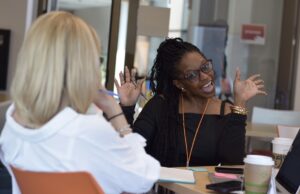
Renee Tribbett joined PeerForward, then called College Summit, back in 2014. She didn’t start as the Managing Director of Operations. In fact, she didn’t start on the operations team at all! Her first role was as an Executive Assistant to the Chief Executive Officer, Chief Advancement Officer, and the President. For three years, she managed their calendars, scheduled their travel, attended their meetings, liaised with PeerForward’s Board of Directors, and more.
Slowly, her role began to evolve. She was ‘filling in the gaps’ where she saw them, becoming heavily involved in event management. One suchevent was a gala where she had the opportunity to see current CEO, Gary Z. Linnen, orchestrating an “I Am Symphony.” Usually performed at PeerForward’s end-of-Workshop banquets, the “I Am Symphony” involves Alumni sharing their stories in a powerful display of spoken-word. Renee was deeply moved by what she saw and, despite enjoying her work as an EA, began to wonder what other positions she could step into.
Renee has always been a fan of “working in the background.” That was one of the aspects she appreciated about her role as an Executive Assistant. As a result of her tireless and often unseen work, Renee was promoted to Managing Director of Operations. This new role allowed her to continue her “behind the scenes work,” only this time for the entire organization.
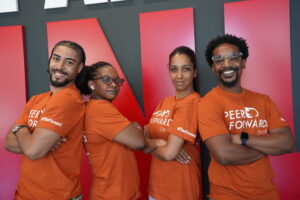
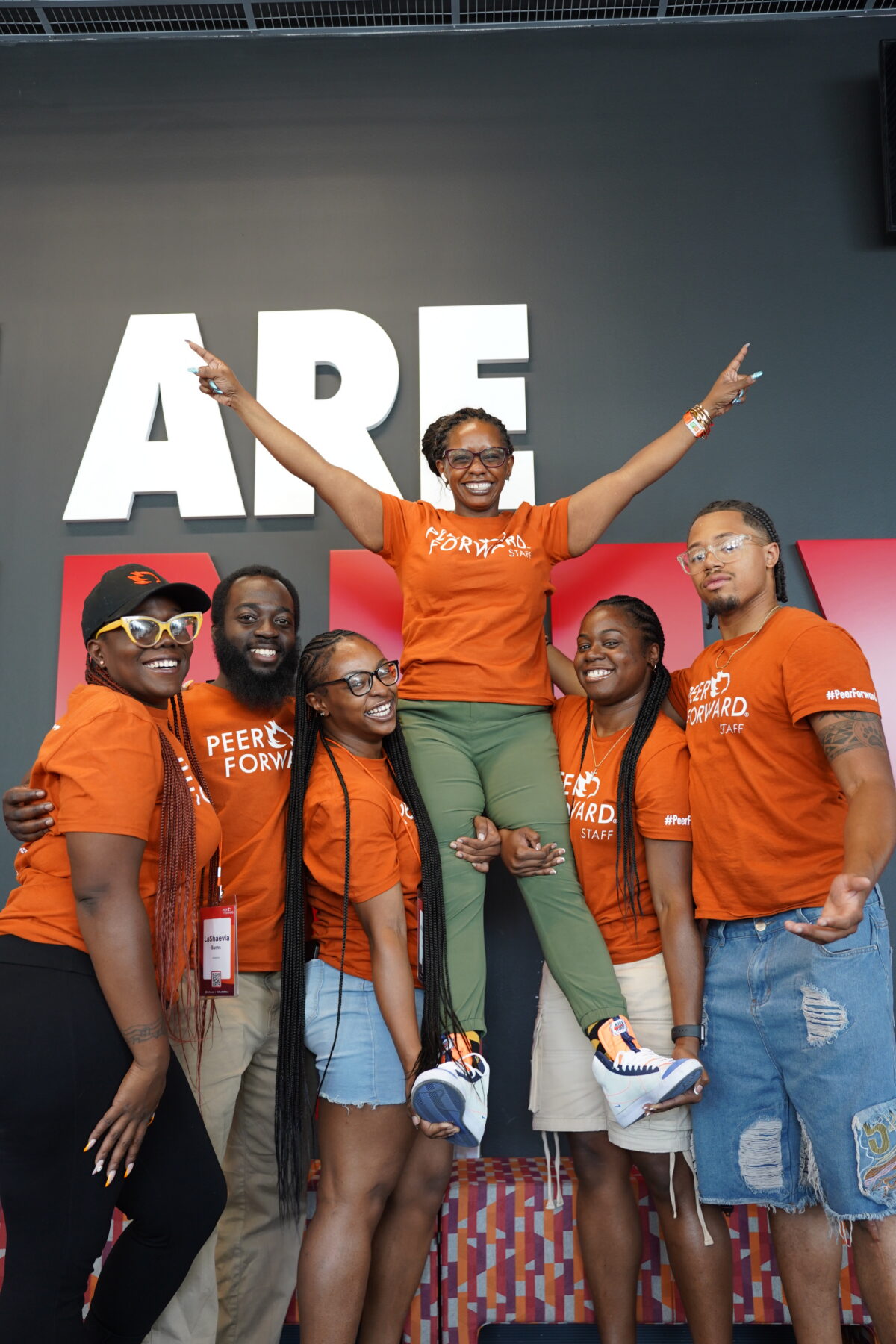
As of 2026, PeerForward’s operations department is small but mighty. Affectionately referred to as Black Ops, the full-time staff team consists of Managing Director of Operations, Renee Tribbett, Alumni Affairs and Volunteer Engagement Manager, Prince Taylor, Manager of Program Operations, Chrisann Bramwell, and Program Coordinator, Rumeal Soler.
Each plays a unique role that contributes to the synergy of the team. Renee described Rumeal as the muscle of the group. She praised his energy, noting that he loves to be on the move and is always doing something. Prince, on the other hand, was called the thinker of the group. Renee spoke highly of his levelheaded nature and analytical approach to problem solving. Chrisann was characterized as the calm, cool, and collected member of the team. Renee emphasized her ability to work well under pressure, always staying composed even in moments of crisis.
When asked to describe her own role, Renee explained that, despite being the Managing Director, she likes to think of herself as just another member of Black Ops. “I may technically lead the team, but I’m still a part of it in the same way they are. I never ask the group to do something that I wouldn’t do,” she shared.
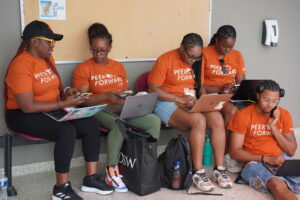
While the Operations Department only consists of 4 full-time employees, they aren’t doing the work alone. Over the past year, PeerForward did something never done before in our 30 years of operation: create, train, and certify an operations development cohort. The program trains Alumni on how to execute large-scale events by honing event planning, project management, and logistics skills. Referred to colloquially as “First Class,” this cohort consists of KeShaun Luckie, Alivia Graham, Taylor Bramwell, Lashaevia Burns, Krystal Bydonne, Khadeejah Woods, Delvoun McClain-Smith, and Chrisann Bramwell. During the 2026 Workshop season, all 8 members of the program were certified. To Renee, these certifications were a standout moment:
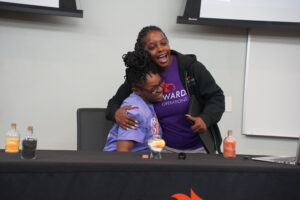
“The standout moment of this season for me was being able to pass the torch at the certification ceremonies of our ops cohort. I have a development area where I need to be able to step back. I can’t be everywhere at once. Being able to have 8 individuals who wanted to do this work and go through the training means everything. They’ve had to give hours of their time outside of what they’re already doing in their personal and professional lives to go through this rigorous process. Being able to be there and lead these certifications during this year’s Workshops was very fulfilling to me. This cohort is the first of its kind in PeerForward. While I love working in the background, it is nice to see my team getting support. We support the coaches. We support the entire organization. When something needs to happen, we are the ones there. I felt it was very important that we bring in a new group of folks who can carry this work along. Year-round, Operations is only a four-man team. When you’re organizing and setting up events as complex as Workshops and Training Camps for 600-800 people a year, you need that kind of backbone to be there to support you. That is what this cohort has been for me. I’m glad there was a group of folks who actually enjoy doing this work like I do. Being able to celebrate them was a major highlight of the season.”
As mentioned, when it comes to Workshops, the operations team is the one to make things happen. While coaches take on front-facing positions, Black Ops are in the background making sure things go off without a hitch. From choosing each campus to registering each attendee, the team does it all. However, what they handle on the ground only accounts for a small portion of their roles. Prep for next year’s Workshop season starts almost immediately after the current one ends. Renee went more in-depth about the timeline and what it takes to prepare:
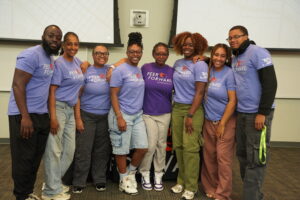
“If I think about it, Workshop prep is a year-round job. Let’s say we finish Workshops at the end of July. The early part of August, once we have rested, we are doing all the final reporting, examining the numbers, the analyzing the costs of the Workshops. From September to November, we do a lot of prep work. We immediately start searching for venues and going through the contract process. We also start looking at job descriptions while beginning the process of figuring out how we’re going to bring our seasonal staff on board. At this time, we’re also scheduling the Workshop Staff Training. We are looking at what supplies we need based on the prior season. Each year, it’s a learning process. No two Workshops are the same. We’re asking ourselves what supplies we will need and how many students do we expect to attend. Then, in January, we put out our applications for our seasonal staff and our volunteers. We are deep in the recruitment process right off the bat. There are a lot of interviews we have to do. We conduct about 150 to 200 interviews a year, whether they’re for the Alumni positions or the volunteer positions. We are also confirming the locations at this point. The team starts working with the coaches to begin the applications for registration for the advisors and the Peer Leaders. Then, in the mix of all that, we’re tracking recruitment numbers, we’re ordering supplies, we’re showing up to the trainings, and making sure everything is in place. This involves creating and updating the manuals in collaboration with the coaches as well as developing the schedule for when we’re on the ground. In the background of this whole process, we are looking at how we can be more efficient and spend less without sacrificing the fidelity of our program.”
As we celebrate 30-years of PeerForward, we are looking to spotlight every team that makes our work possible. Thank you to our operations department and cohort for all that you do. Though your work is done behind the scenes, every aspect of PeerForward relies on your support. Your contributions to our organization don’t go unnoticed!